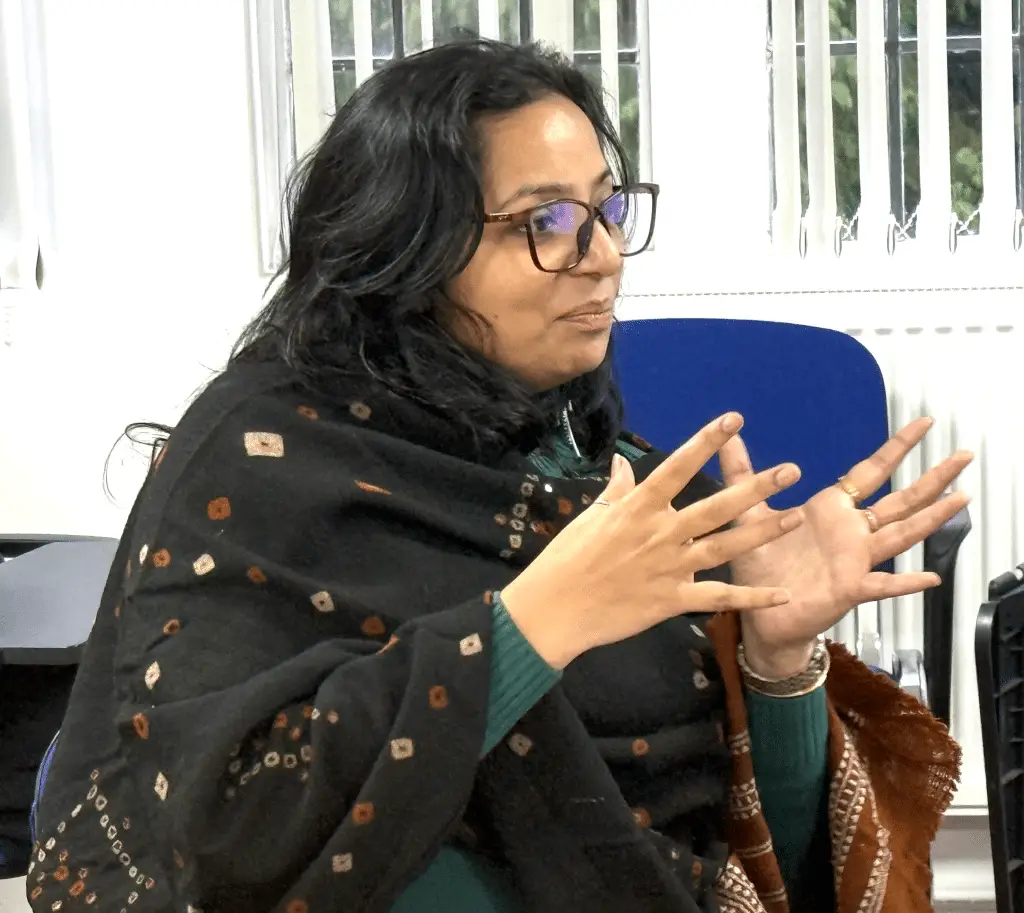
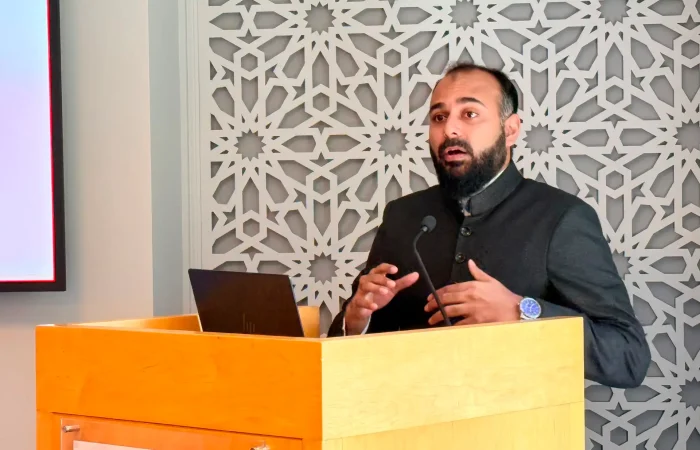
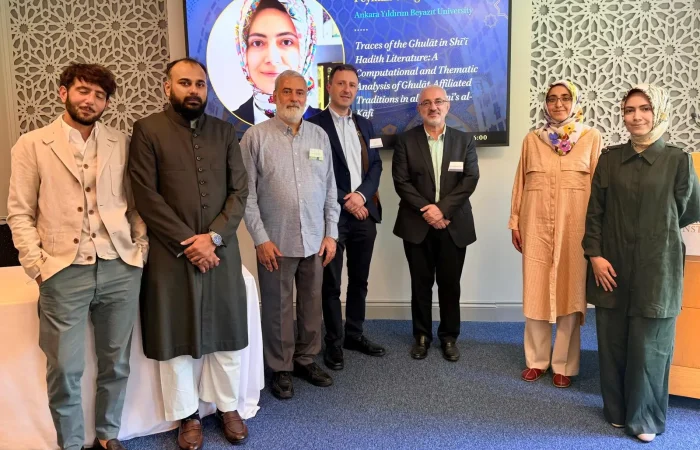
On 26th November 2025, AMI welcomed Dr Zairu Nisha from the University of Delhi to explore a critical dimension of feminist bioethics and phenomenology: the concept of moral injury as it applies to infertility and technologically mediated reproduction among Muslim women in India. In societies where infertility is considered both a socio-religious problem and a medical disease intertwined with gendered suffering, Dr Nisha’s research challenges us to reconsider who bears the moral burden when the body fails to meet reproductive expectations. Drawing from feminist bioethics and phenomenological philosophy, her presentation revealed how infertility becomes simultaneously medicalised, spiritualized, and moralised, transforming the woman’s body into what she terms a “site of moral injury.” This moral injury, she argues, arises not merely from bodily failure but from the deeply gendered entanglement of technology, belief, and moral responsibility.
Key Findings
The Lived Body and Intersubjective Moral Injury
Dr Nisha began by examining a fundamental question: the relationship between self and body. Western philosophy from Plato to Descartes, and Indian traditions such as the Samkhya school’s distinction between puruṣa (consciousness) and prakṛti (matter), have consistently subordinated the body to the mind, treating it as opposite, independent, and separate, valued only to anchor the self. Even phenomenology, while recognising embodied subjectivity, ultimately privileges consciousness. Dr Nisha turned to Maurice Merleau-Ponty’s concept of the “lived body” to propose an alternative: “we are our bodies,” and this body thinks, feels, and acts as a moral subject in the lived world. Crucially, she drew attention to intersubjectivity; our lived bodies exist in a reciprocal relationship with others. While essential to human existence, this intersubjectivity becomes the very locus of moral injury. When others’ perceptions and judgements collide with our embodied reality, the wound strikes at the core of our moral being.
Infertility, Femininity, and the Architecture of Moral Injury
The concept of moral injury, Dr Nisha explained, originated in military psychology to describe the wound of conscience that occurs when individuals perceive themselves as betraying deeply held values or experience betrayal by trusted institutions and authorities. Such experiences shatter moral identity, leading to guilt, shame, and alienation. Applied to reproductive suffering, it describes a similar collapse of meaning where women’s embodied realities collide with moral, social, and religious expectations of fertility and divine order. Invoking Simone de Beauvoir’s assertion that “woman is a womb,” Dr Nisha unpacked how society essentializes womanhood around reproductive capacity: procreation is biological, but motherhood is a social construct that sets a woman’s identity, self-worth, and status. The absence of a child is perceived as misfortune, betrayal, spiritual deficiency, or divine displeasure. Women describe their bodies as “betraying” them, yet this injury is a double-edged sword. alienation from the moral community that devalues the infertile woman, and an internal crisis of faith wherein divine justice appears inscrutable. The injury stems not from wrongdoing but from being trapped within conflicting moral worlds.
Technology, Muslim Women, and Pathways to Moral Repair
Dr Nisha examined how assisted reproductive technologies intersect with this moral landscape. ART clinics have medicalised reproduction, turning intimate experiences into clinical problems requiring technological solutions and reconfiguring the body as a site of diagnosis, intervention, and control. The woman becomes patient and bearer of familial redemption through technological compliance. Despite success rates of only 18-20%, when technology fails, the blame falls on the woman. Dr Nisha describes this as “technological piety,” where faith and science co-construct ethical meaning, while technology remains “smart enough not to take responsibility.” For Muslim women, procreation is both a moral duty and an act of faith, with fertility understood as a divine blessing. Infertility becomes mediated through divine will (qadar) and moral testing (ibtilāʾ), leading women to oscillate between divine submission and personal despair. Dr Nisha concluded that healing requires acknowledgement, empathy, and reparation from others, not merely self-forgiveness. Reciprocity between lived bodies serves as a healing condition, and within Muslim contexts, this involves reimagining religious narratives. This reimagining goes beyond essentialising motherhood as a woman’s fixed destiny, recognising that infertility is as natural as fertility.
About the Speaker
Dr Zairu Nisha is an Assistant Professor in the Department of Philosophy at Ramanujan College, University of Delhi, and an Al-Mahdi Institute Visiting Fellow. Her research spans a wide intellectual landscape, including Indian and Western Philosophy, Bioethics, Feminism, Continental Thought, Philosophy of Technology, and Philosophical Counselling. Dr Nisha has shared her scholarship at numerous conferences, seminars, workshops and lectures around the world, earning recognition for her scholarly versatility and depth. emotional worlds are constructed through storytelling.