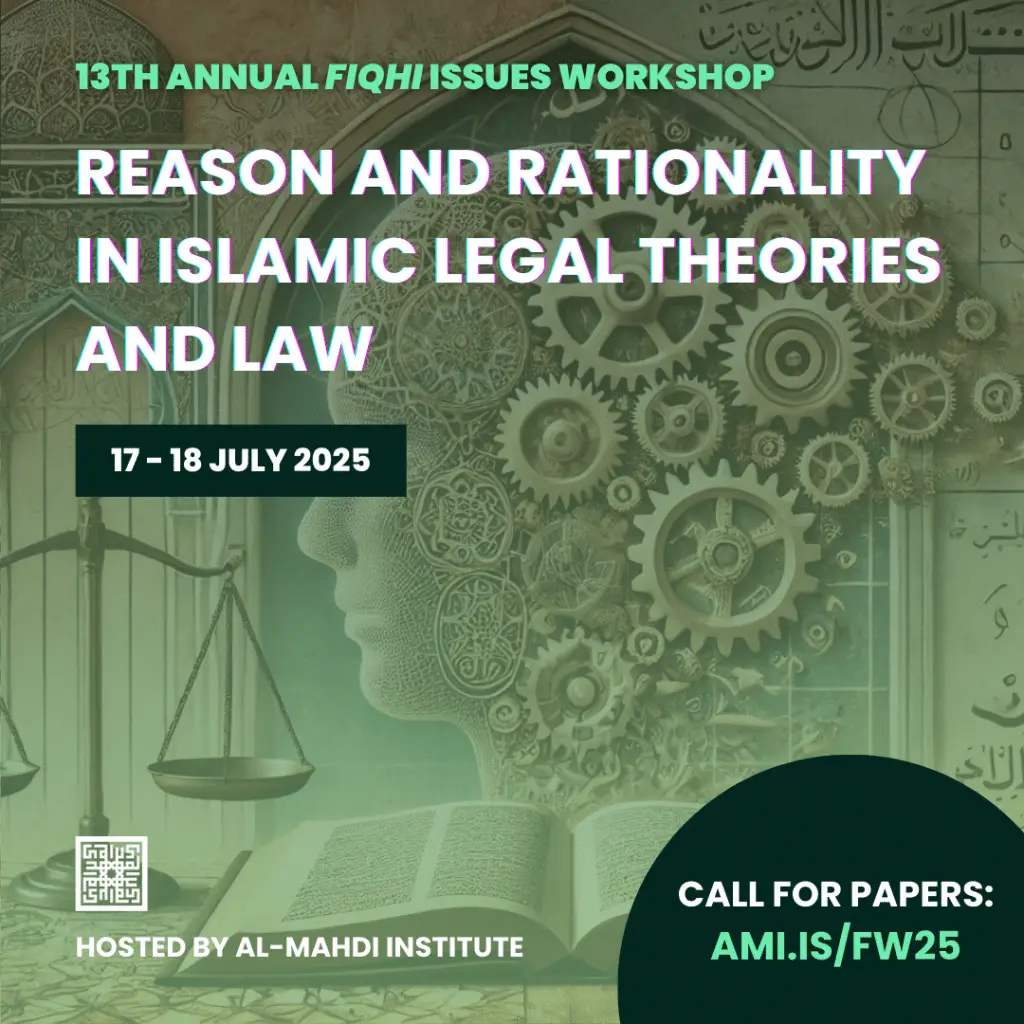
AMI’s Department of Islamic Legal Studies invites submissions for its 13th annual Contemporary Fiqhi Issues workshop, titled ‘Reason and Rationality in Islamic Legal Theories and Law’ to be held on 17th – 18th July 2025. The deadline for abstract submissions is 30th January 2025.
Reason (ʿaql) in Islamic legal theory serves both as a clarifying tool addressing complexities of life, and as a bridge between divine revelation (naql) and human experience. Central for applications of Islamic jurisprudence, reason affords a coherent and adaptable approach to interpreting divine revelation. Rational techniques enable a flexible understanding of Islamic law by aligning principles of justice, utility and wellbeing with divine imperatives. Employing human reason may enhance the flexibility and adaptability of Islamic law by enabling jurisprudence to more adequately address contemporary ethical and social challenges, while remaining anchored in its foundational sources and commitment to divine guidance.
We invite scholars to contribute to an interdisciplinary workshop exploring the nuanced roles of reason and modes of rationality in Islamic legal theory and law. This workshop examines functions of rational procedures and thinking in Islamic jurisprudence, and how they shape moral and legal reasoning responsive to changing human contexts. Joining scholars from a variety of intellectual disciplines, Qur’anic studies, philosophy, theology and legal theory, we hope to foster a rich interdisciplinary dialogue. This exchange may deepen understanding of how rationality, natural law, public reason, and human dignity are applied across traditions, enriching the broader discourse on ethical purposes of the law for human wellbeing or social utility in historical, contemporary, religious and secular contexts.
Islamic doctrinal and legal schools took various approaches to integration of reason and revelation. The ʿAdliyya, both Muʿtazila and Shiʿa (Imāmī & Zaydī) emphasised the rationality of moral principles by asserting that intrinsic rational good and evil (al-ḥusn wa al-qubḥ al-ʿaqlī) are discernable by means of reason—being crucial for upholding divine justice and human moral obligation (taklīf ). In contrast the Ashʿarites, while recognising the moral role of reason, awarded revelation precedence when conflicts arise between reason and revelation. This reflects their intermediate stance on the scope of human rationality within legal and theological matters. Apart from this ʿAdliyya–Ashʿarī binary of rationalism versus textualism, significant epistemic issues regarding the weight awarded reason beyond the Sharīʿah differentiated Islamic legal schools with practical implications for jurisprudence. These debates influence how legal theorists approach primary and secondary sources for jurisprudential reasoning, shaping broader discussions over justice, fairness and human welfare.
Workshop Themes:
The workshop will address a range of topics within the framework of reason and rationality in Islamic law and legal theory, including:
Definition and Scope of Reason:
- Conceptions of reason (ʿaql) in Islamic ethical, legal, doctrinal, or philosophic teachings
- Ontology and epistemology of reason: g., the self – hierarchy – creation
- Objectivity or subjectivity of Islamic norms
- Universal conduct and practice of rational agents (bināʾ al-ʿuqalāʾ / sīrat al-ʿuqalāʾ)
Authority of Reason – Differing Muslim Perspectives:
- Conflicts between revealed and rational injunctions
- Ashʿarī and Māturīdī views
- Muʿtazilī, or Zaydī views
- Imāmī Usūlī, or Imāmī Akhbārī, views
Applications of Rationality in Islamic Law:
- Key Issues – as independent evidence; pre-requisites; opposites (ḍidd); sufficiency or adequacy (ijzāʾ)
Modernity and Islamic Reason:
- Recent reformist views
- Gender equity
- Post-Enlightenment instrumentalism vs. epistemic sovereignty & decoloniality
Abstract Submission Guidelines:
Applicants are invited to submit an abstract of 300–500 words, and a CV (maximum 2 pages, including publications and recent work experience) in MS Word or PDF format. Authors should also provide a brief paragraph of biodata. Submissions should be sent to [email protected] by 17:00 UK time, January 30th 2025.
Key Dates:
- Abstract Submission Deadline: January 30, 2025.
- Notification of Acceptance: March 15, 2025.
- Workshop Dates: July 17–18, 2025.
- Full Paper Submission Deadline: November 30, 2025
Workshop:
Selected abstracts are invited for presentation in the two-day workshop at Al-Mahdi Institute, 60 Weoley Park Road, Selly Oak, Birmingham B29 6RB. Each presenter has 20 minutes to present their paper, followed by a short discussion. All presenters are expected to stay for the full duration of the conference. Hospitality and accommodation will be provided. While participants are encouraged if possible, to cover their own travel expenses, reasonable economy travel costs will be reimbursed for those who require assistance.
Publication:
The final proceedings of the workshop will be published in an edited volume. Full papers must adhere to the house style of the Institute’s publishing guidelines and be between 6,000–10,000 words (excluding bibliography). Final submissions should comply with the Chicago Manual of Style. Any additional formatting requirements will be communicated to authors in due course.
Submission Instructions for Full Papers:
Full papers should be submitted in MS Word format to [email protected] no later than 17:00 UK time, November 30th, 2025. The first page of the manuscript should include:
- Title, Author’s name(s) and Institutional Affiliation(s)
- A Short Biodata
- Contact details (address, telephone & email).
- Abstract (300–500 words).
- Keywords (up to 6)
- Bibliography.
For any further queries, please contact: [email protected]