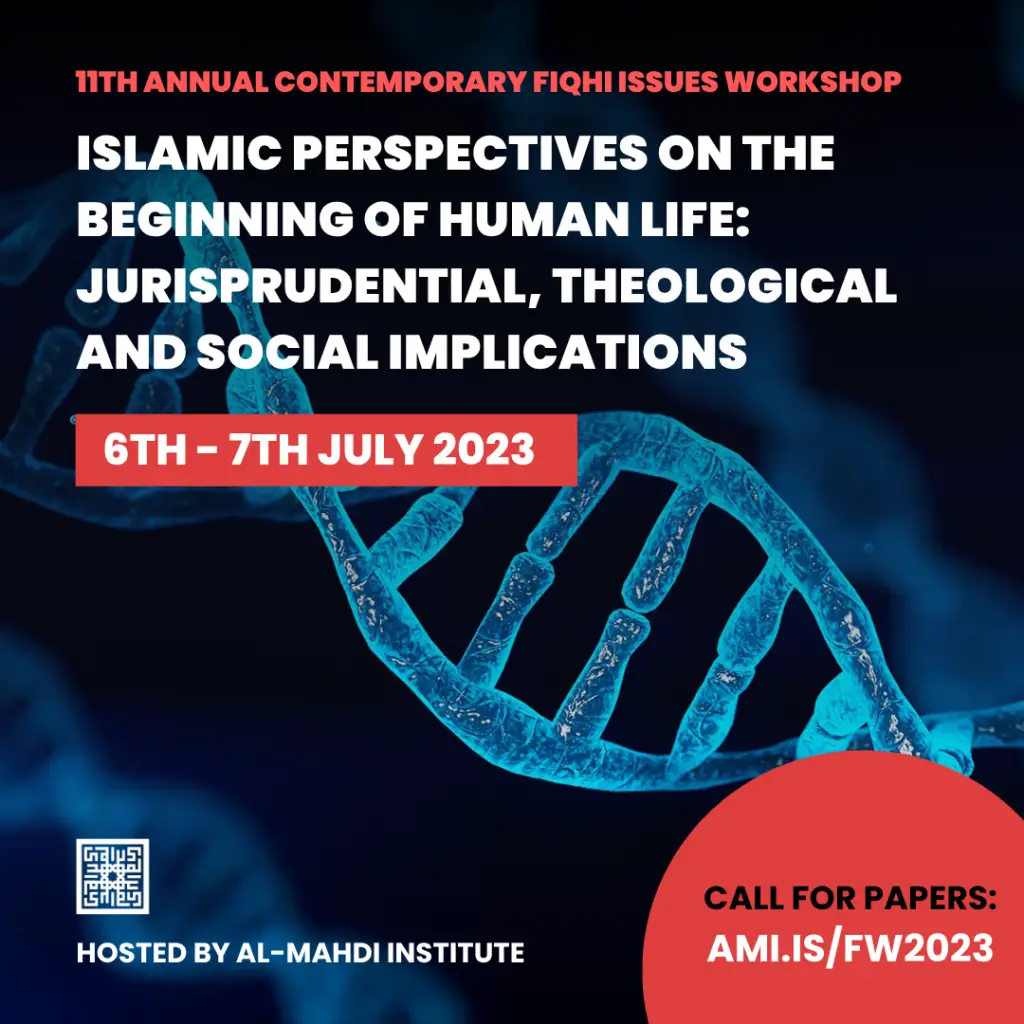
Al-Mahdi Institute’s (AMI) series on Contemporary Fiqhī Issues facilitates critical discussions on challenges faced by Muslims in everyday life. The workshop brings together experts in traditional Islamic sciences of various dispositions, academics, and individual’s working with grass root communities, enabling a dialectic between theoreticians and practitioners who understand the day-to-day problems, resulting in a multi-disciplinary publication. The 11th Contemporary Fiqhī Issues workshop will take place on 6th-7th July 2023.
About the Workshop
AMI hopes to facilitate scholarship on “Islamic Perspectives on the Beginning of Human Life: Jurisprudential, Theological and Social Implications.” Medical practices and technologies relating to human reproduction raise a host of issues for Muslims. For instance, researching the human genome provides a greater understanding of certain fatal diseases, like some forms of cancer, and improves prospects for creating cures and alleviating the suffering of many people. Ongoing work in this field means that it could be possible theoretically to clone specific human cells to treat patients with currently untreatable conditions and to grow organs for transplantation. Although most countries have strict laws preventing cloning, it is also possible, in theory, to make human clones or modify the DNA in such a way that the changes are passed on to the following generations. This raises theological problems:
- Can the creation of God be altered?
- Would it then possess the ‘spirit’ breathed into humans by God?
From the jurisprudential lens, there are questions over the permissibility of creating human embryos for research purposes that will be destroyed, which is related to the debate on abortion. From a social and ethical perspective, there is the concern that newer technology, like genome editing, will only be accessible to the wealthy, increasing existing disparities in access to health care. Aside from genetics, there are a host of other contemporary medical practices relating to the beginning of human life, including abortion, assisted reproductive techniques, surrogacy, sperm and egg donation, all of which have various jurisprudential, theological and social implications. Furthermore, as our technology continues to advance and our knowledge base expands, we are inevitably, and perhaps most importantly, brought back to fundamental questions about human origins and personhood.
Call for Papers
The workshop welcomes proposals that build on, or fill the gaps in the current academic literature across different disciplines. We welcome the following contributions:
- Seminary trained scholars who can deal with the theological and jurisprudential of modern reproductive techniques.
- Social scientists, anthropologists and medical practitioners who detail how Muslims deal with such issues.
- Philosophers, ethicists and academics can inform broader theoretic discussions, for example, on the nature of the soul or foetus.
Application Requirements
In submitting an application to present at the workshop, applicants also commit to submitting a 6,000-10,000 word article by 6th November 2023.
Proposals for a single presenter should include the following:
- Tentative title and Abstract (400-word limit).
- The deadline for abstract submission is 17th April 2023
- Successful applicants will be notified by 23rd April 2023
- Applicant’s brief bio and CV (maximum two pages highlighting the applicant’s publications and recent professional positions)
Applicant’s contact information. Proposals and queries should be sent by e-mail to [email protected].
All accepted applicants will have their accommodation and board arranged by AMI, and the travel logistics being borne for presenters from the UK and the EU.