About the Podcast:
- How and when did Shia Muslim communities establish themselves across Britain—and why has this history remained under-researched?
- What can ritual reveal that the dominant lenses of sectarianism, diaspora, and institutional history overlook?
- How did women’s organising, domestic labour, and ritual knowledge help build Britain’s earliest Shia spaces?
- How have geopolitics, transnational religious authority, and local pressures shaped the emergence of “British Shia Islam”?
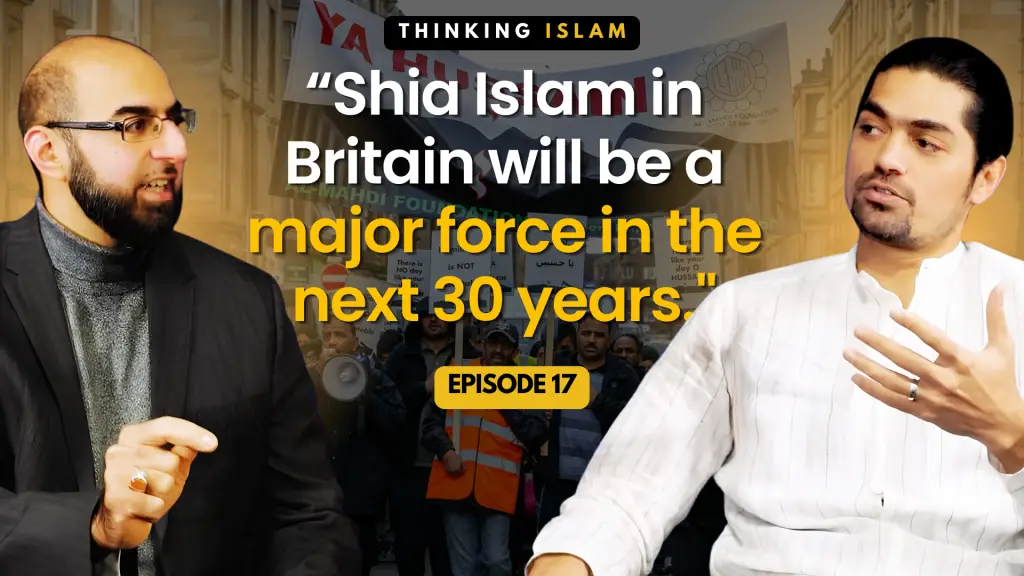
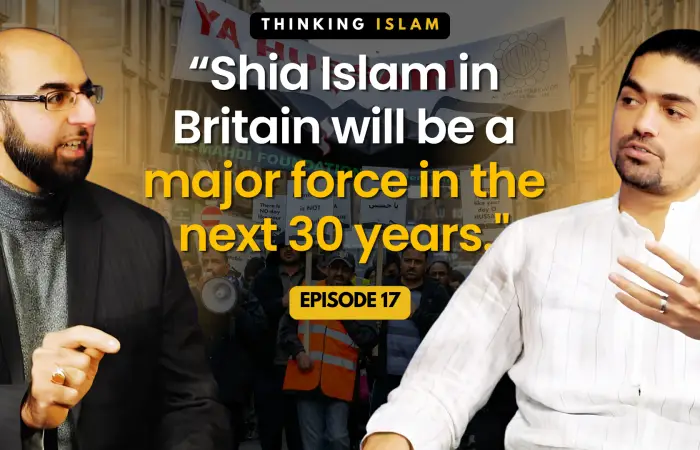
In this episode of Thinking Islam, Dr Jaffer Mirza traces the overlooked history of Shia Muslim settlement in Britain between the 1950s and the 1980s. Drawing on more than one hundred oral-history interviews and fieldwork across nine cities, he asks when recognisable Shia communities began to emerge and why their stories have remained largely absent from British Muslim history. Dr Mirza challenges three dominant ways of studying Shia life—sectarianism, diaspora, and institutional history—arguing that each can obscure the fluid, local, and everyday processes through which communities are formed. By turning to ritual, he shows how Muharram gatherings, majalis, processions, and shared spaces reveal relationships that fixed communal categories often miss.
The conversation explores what Dr Mirza calls the multiplicity of ritual: its capacity to unite communities while also producing disagreement, distinction, and new institutions. Rituals brought Shia and Sunni Muslims together in some early British settings, yet differences over practices such as matam and tatbir could also divide Shia communities themselves. Particular attention is given to women, whose ritual knowledge, domestic labour, fundraising, and organising were foundational to Shia settlement in cities including Glasgow, Birmingham, Newport, and London, even though their names are often missing from institutional archives.
The discussion then widens to the impact of geopolitics and local politics. The Iranian Revolution increased Shia visibility, Saddam Hussein’s surveillance forced some Iraqi Shia gatherings into secrecy, and Islamophobia and charity regulation continue to shape how communities present and govern themselves. Dr Mirza also reflects on the contested idea of “British Shia Islam”, arguing that belonging is negotiated across British, Scottish, Welsh, ethnic, linguistic, and religious identities rather than imposed through a single diasporic model. Ultimately, the episode asks how Britain’s Shia communities can preserve ritual life while investing in education, welfare, scholarship, and the wider institutions needed for a sustainable future.
Watch Now:
Listen Now:
Learn More About Our Guest:
Dr Jaffer Mirza is a researcher whose work explores the history of Shia settlement in Britain, ritual, migration, community formation, and freedom of religion or belief. Drawing on oral history and fieldwork across nine British cities, his research brings overlooked voices and everyday practices into the study of Islam in Britain.
Read More of His Insights:
Mirza, J.A. (2024) ‘Shi’i Materiality Beyond Karbala: Religion That Matters ed. by Fouad Gehad Marei, Yafa Shanneik & Christian Funke’ (review), Journal of Shi’a Islamic Studies, 17(1), pp. 109–112. Available at: https://muse.jhu.edu/pub/197/article/949481