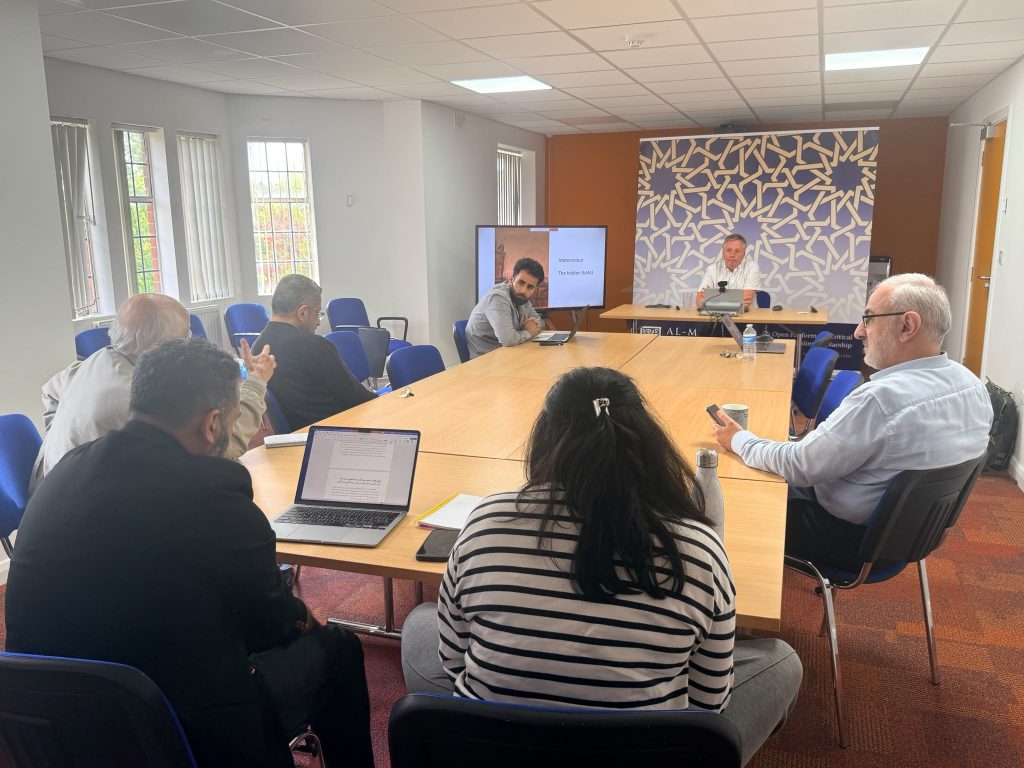
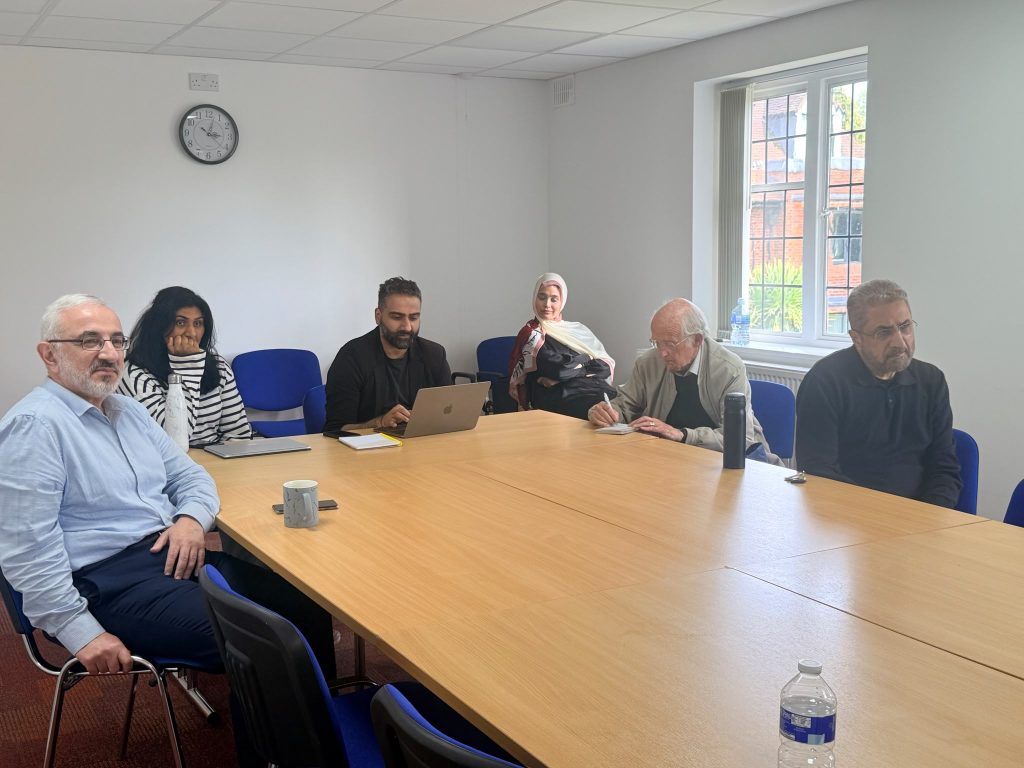
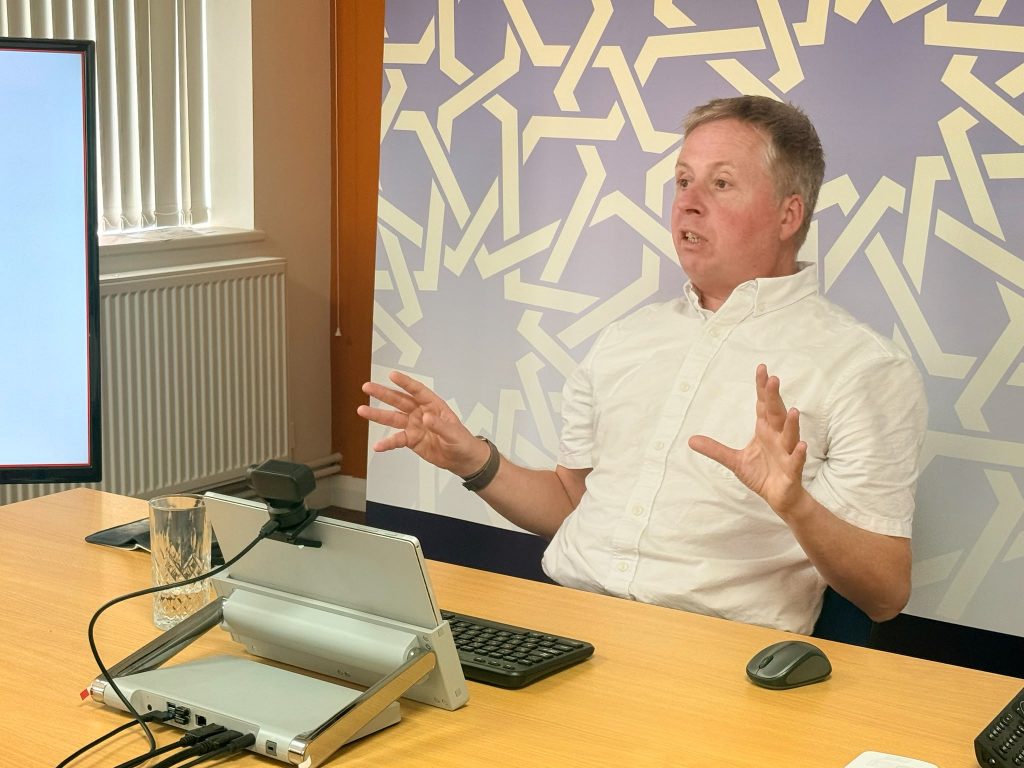
On 29th April 2026, AMI welcomed Professor William Gallois from the Institute of Arab and Islamic Studies at the University of Exeter to explore a question that remains largely unresolved within art history: was there such a thing as modern Islamic art? Challenging the dominant view that the colonial period marked the end of Islamic visual culture, Professor Gallois argued instead that it was a period of profound artistic transformation — one in which Muslim communities across the colonised world produced sophisticated, often clandestine, responses to empire in explicitly religious visual forms.
Key Findings
What Is Islamic Art?
Professor Gallois identified two poles that have conventionally defined Islamic art: the geometric tradition of architecture and decorative crafts, and the figurative world of the illuminated Persian miniature. Both, he argued, share a devotional logic — drawing on the Harvard scholar David Roxburgh’s observation that Persianate painting rewards “endless return,” in the same way a hadith scholar never exhausts a text but finds new meaning through sustained engagement. He also challenged the widely held assumption that aniconism — the avoidance of the human figure — is a transhistorical feature of Islamic art, identifying it instead as largely a 19th-century invention of Western scholarship, one that has distorted our understanding of Islamic visual culture ever since.
Empire, Visual Culture, and the Question of the Modern
For Gallois, the “modern” is not an aesthetic category but a historical one: the colonial period, from France’s arrival in Algeria in the 1830s through most of the 20th century. European imperialism brought three interconnected crises to Islamic visual culture — the destruction of craft economies, the imposition of Orientalism as the dominant representational framework, and the arrival of European art forms (the framed painting, the sculpture) as the new standard of culture. Against this backdrop, he offered a critical reading of Muḥammad ʻAbduh’s influential 1904 fatwā on images and statues, arguing that ʻAbduh’s endorsement of European art as Islamically permissible was founded on ignorance of both Western and Islamic visual tradition, and that its lasting influence has narrowed rather than enriched how Muslims and others have understood the place of art in Islam.
Art as Resistance and Religious Meaning
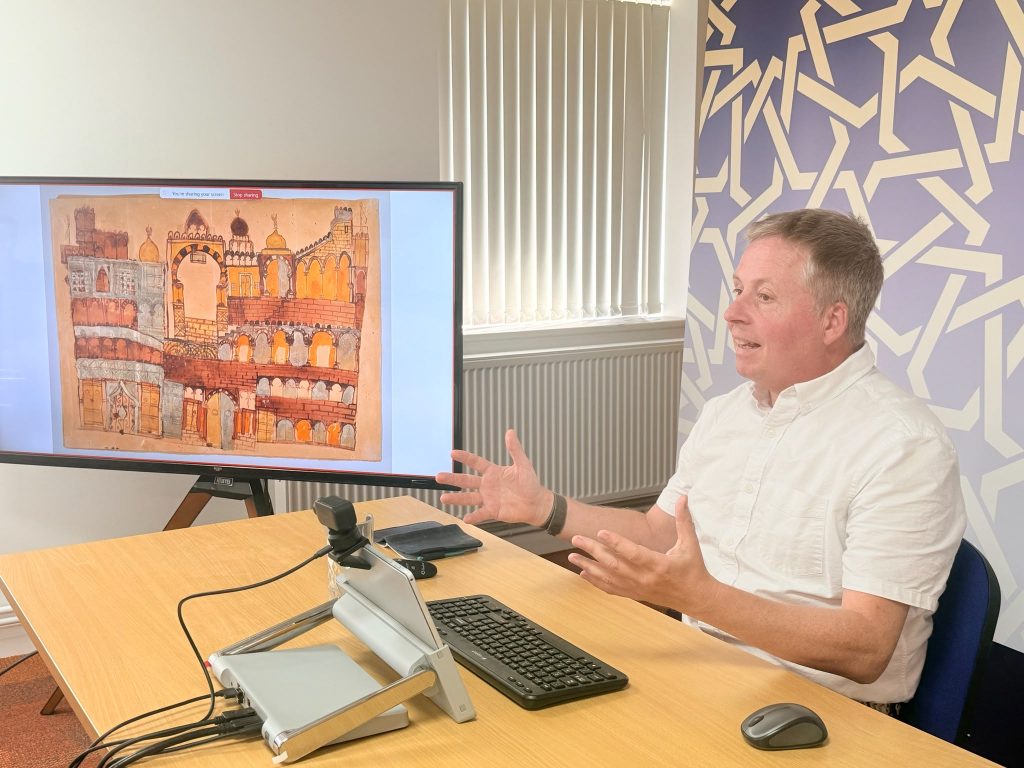
Gallois illustrated his broader argument with two cases. In Senegal, the Muridīyya Sufi order — founded by Aḥmad Bamba at the turn of the 20th century — generated one of the most image-saturated Islamic cultures in the world, using visual culture as direct anti-colonial resistance. French colonial authorities recognised the threat: the Governor-General ordered the destruction of Islamic engravings circulating in the country, understanding them as instruments of political mobilisation. A single French police mugshot of Aḥmad Bamba became the iconic image of an entire religious movement, reproduced in reverse glass paintings across the country to this day. Gallois then turned to two anonymous works: a set of dome paintings above a colonial marketplace in El Oued, Algeria, which encoded a typology of African Islamic shrine architecture as a quiet act of identity and resistance; and a Tunisian watercolour later appropriated by Paul Klee, whose concealed fifth dome — a visual expression of the Islamic concept of the bāṭin, the hidden — could only be discovered through sustained, spiritually attentive looking. In both cases, the religious meaning of the work was invisible to those who did not bring the right sensibility to it — and it is this quality, Gallois argued, that defines modern Islamic art.
Watch the Seminar
Listen to the Seminar
About the Speaker
Professor William Gallois is a historian at the Institute of Arab and Islamic Studies, University of Exeter. His research focuses on the visual and material cultures of the colonised Muslim world, with particular expertise in North and West Africa. He is a leading voice in the effort to recover the religious dimensions of Islamic visual culture from both Orientalist misrepresentation and the limits of secular nationalist art historiography.
Gallery