Is science foreign to the Islamic way of thinking?
How can we make scientific sense of the unknown: the realm of the jinn, the Adamic account and the unseen?
If there is intelligent life beyond Earth, does it clash with the notion of human superiority in Islamic theology?
In this episode of Thinking Islam, we sit down with Dr Shoaib Ahmed Malik to ask what we mean by science, what Muslims have made of it, and where it runs out. The conversation moves from the history and metaphysics of science to the jinn, aliens and the realm of the unseen (al-ghayb). Throughout, it asks what science can tell faith, what it cannot, and how the classical tradition equips us to think between the two.
We begin with how Muslims have met modern science, from the Islamisation of knowledge to the scientific miracles of the Qurʾān (iʿjāz ʿilmī). Dr Malik is critical of the latter: the Qurʾān is not a scientific book, and a faith built on science is exposed when the science changes. What matters more are the assumptions beneath science, such as causality and divine action, and here the classical traditions offer templates rather than answers. From there we test the line between science and pseudoscience, putting the same question to prophetic medicine, Islamic psychology and intelligent design: where is the evidence? We weigh the contingency argument against the kalām cosmological argument and the stress test of the multiverse, along with al-Rāzī’s admission that it is the design arguments that move the heart. We then step into the unseen. We look at al-Rāzī’s five models of the jinn, possession and mental health, and why the jinn lead Dr Malik to evolution and Adamic exceptionalism. The conversation ends with aliens, human superiority, his “deflationary theology”, the limits of theology, and a call to think with our tradition rather than merely defend it.
Watch Now:
Listen Now:
About the Guest:
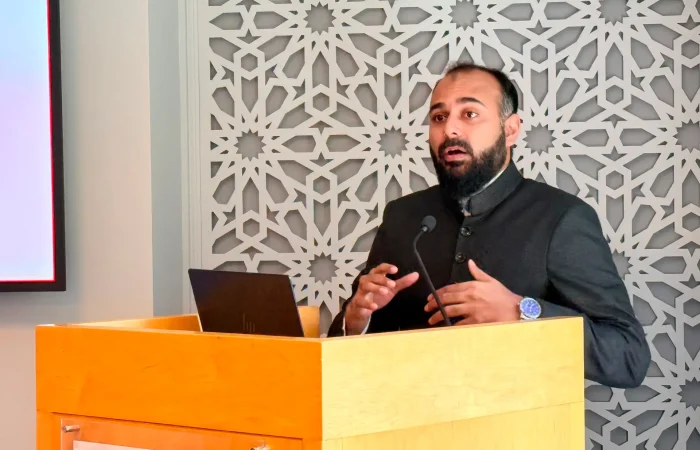
Dr Shoaib Ahmed Malik is Lecturer in Science and Religion at the School of Divinity, University of Edinburgh, and a leading voice in the emerging field of Islam and science. A chemical engineer turned theologian, he graduated top of his cohort in Chemical Engineering at the University of Bath and completed a PhD in Chemical Engineering at the University of Nottingham. He then took an MSc in Philosophy, Science and Religion at Edinburgh and a second PhD, in Theology, at St Mary’s University, Twickenham. Before Edinburgh he taught at Zayed University in Dubai. His monograph Islam and Evolution: Al-Ghazālī and the Modern Evolutionary Paradigm (Routledge, 2021) was recognised by the International Society for Science and Religion in 2022. He is chief editor of Palgrave Macmillan’s Islam and Science book series and encyclopedia. He is currently writing two books: one on natural theology and the ways of proving God’s existence, and one on human nature and uniqueness in light of AI, evolution and extraterrestrial life.
Read More of His Works:
Seven Classical Perspectives for Islam and Science (ed., Routledge, 2026). Open access.
“Fakhr al-Dīn al-Rāzī on the Existence and Nature of the Jinn”, Religions 16, no. 9 (2025): 1141. Open access.
Islamic Theology and Extraterrestrial Life: New Frontiers in Science and Religion (co-ed. with Jörg Matthias Determann, I.B. Tauris, 2024).