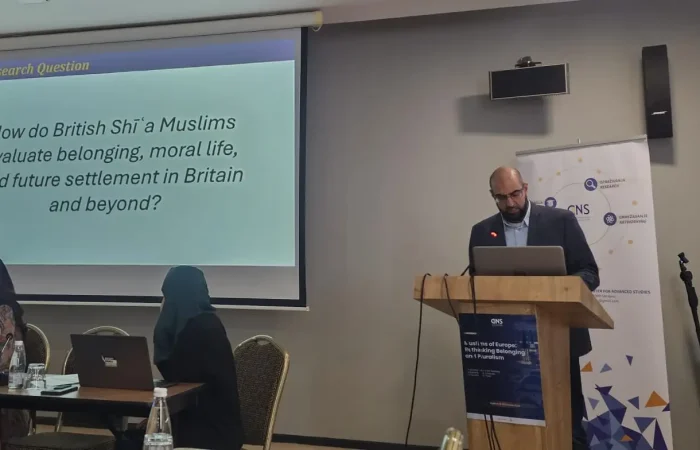
On 2 July 2026, Dr Wahid Amin presented a paper titled “The Burhān al-Ṣiddīqīn after Avicenna: A Problematic History” at the Third Manchester Workshop on Islamic Philosophy at the University of Manchester. The workshop ran on 2–3 July 2026 and was organised by Professor Mohammad Saleh Zarepour, Professor of Philosophy at Manchester. Dr Amin also presented at the Second Manchester Workshop on Islamic Philosophy in July 2025.
Dr Wahid M. Amin, Senior Lecturer in Islamic Philosophy and Theology at Al-Mahdi Institute, presented a paper on Avicenna’s Burhān al-Ṣiddīqīn (“Proof of the Truthful”), his celebrated argument for the existence of God as the Necessary Existent. Unlike arguments that begin from motion or from the origin of the cosmos in time, Avicenna’s proof proceeds from an analysis of existence itself: whatever exists only contingently must ultimately depend on a being whose existence is necessary in itself.
Recent scholarship has done much to reconstruct the logical structure of this proof, asking which premises are strictly required for it to work. Dr Amin asks a different question: how did philosophers within the Avicennian tradition understand what the proof had to explain? His paper focuses on a thirteenth-century correspondence between Najm al-Dīn al-Kātibī and Naṣīr al-Dīn al-Ṭūsī about Fakhr al-Dīn al-Rāzī’s version of the argument. Kātibī did not doubt the proof’s conclusion. Instead, he asked whether every step had itself been demonstrated, in particular the move from the cause of the whole collection of contingent things to the cause of each of its members. Ṭūsī accepted these demands and responded by introducing new distinctions, including between proximate and remote causes, and by clarifying how a whole depends on its parts.
Dr Amin argues that the correspondence is best read as a collaborative refinement of Avicenna’s proof under increasingly demanding standards of demonstration, that Ṭūsī’s replies are a genuine philosophical development of it, and that the exchange offers a valuable guide to how the mature Avicennian tradition understood the argument. He also shows how this historical debate complements modern reconstructions of the proof, such as that of Mohammad Saleh Zarepour. Dr Amin is currently developing the paper for publication.
Other participants at this year’s workshop included Kamran Karimullah and Mohammad Saleh Zarepour of the University of Manchester, Frank Griffel of the University of Oxford, Ahmed Alwishah of Pitzer College, Mahrad Almotahari of the University of Edinburgh, Ayşenur Ünügür Tabur of the University of Birmingham, and Stefan Melchert of the University of Bonn.
This paper forms part of Al-Mahdi Institute’s research in Islamic Philosophy and Theology, one of the Institute’s research areas, which examines the classical philosophical and theological traditions of Islam alongside the questions they raise for contemporary thought.
About Dr Wahid Amin
Wahid M. Amin is Senior Lecturer in Islamic Philosophy and Theology at Al-Mahdi Institute. His research focuses on Avicenna and post-Avicennian philosophy and intellectual history, as well as pre-modern and contemporary Shia legal theory. Further detail is available on his faculty profile.