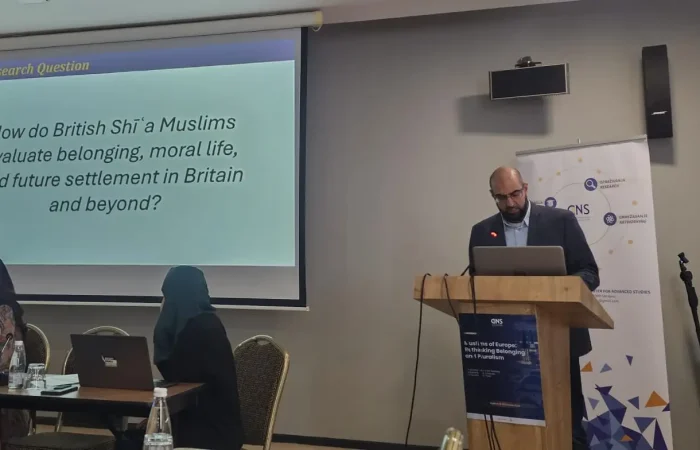
Dr Muhammed Reza Tajri, Research Lead for Muslims, Societies and Cultures at Al-Mahdi Institute (AMI), took part in the international conference Muslims of Europe: Rethinking Belonging and Pluralism, held in Sarajevo, Bosnia and Herzegovina, on 9–10 October 2026. Convened by Professor Ahmet Alibašić of the Faculty of Islamic Studies, University of Sarajevo, and Director of the Center for Advanced Studies (CNS), the conference brought together scholars from sociology, history, Islamic studies and political science to examine the historical and contemporary place of Muslims in Europe, with particular attention to identity, citizenship, migration, Islamophobia, securitisation and emerging forms of Muslim belonging.
Representing AMI, Dr Tajri presented a paper entitled “Precarious Belonging: Shīʿa Diasporas and the Strains of European Pluralism”. His contribution formed part of a panel on “Negotiating Muslim Belonging in Britain”, alongside Muhammed Sacid Tastepe, who examined Muslim identity and belonging in Britain in the wake of the Gaza crisis, and Canan Ates, who explored the place of Sharia Councils within Britain’s legal and colonial inheritance.
Drawing upon his ongoing sociological research with British Shīʿa Muslim communities, Dr Tajri’s presentation addressed the comparatively limited attention given to Shīʿa Muslims within the sociology of Muslims in Europe. While scholarship on Islam and Muslim communities in Europe has grown considerably, the particular theological, ritual and transnational characteristics of Shīʿa diasporic life remain insufficiently represented within wider discussions of integration and belonging.
The paper examined the continuing importance of transnational religious and cultural attachments, particularly to shrine cities and religious centres in Iraq and Iran, in shaping Shīʿa Muslim identities in Europe. Dr Tajri argued that these attachments complicate straightforward understandings of integration, as diasporic Muslims may simultaneously develop attachments to European societies while maintaining powerful religious, cultural and emotional connections elsewhere. Central to the paper was the concept of “cultural defensiveness”, used to examine how communal and religious boundaries can become more pronounced in response to perceived social, political and geopolitical pressures.
The presentation further considered how contemporary geopolitical tensions, the securitisation of Muslim institutions, Islamophobia, and the rise of far-right politics across Europe can intensify questions surrounding British and European belonging. Rather than understanding such experiences solely through the language of marginalisation, the paper suggested that these pressures may increasingly reshape diasporic trajectories themselves, including decisions by some Muslim families to seek alternative social and religious environments outside Europe.
An especially enriching aspect of the visit was the opportunity afforded to delegates to explore Sarajevo itself. A guided tour through the city’s historic quarters highlighted Sarajevo’s distinctive Islamic and European heritage, while visits to sites and memorial spaces associated with the Bosnian war offered a powerful reminder of the violence, displacement and genocide experienced within recent European history. The location was particularly significant for a conference concerned with Muslim belonging: as the organisers themselves emphasised, Sarajevo provides a distinctive vantage point from which to reflect on a Muslim presence that has long constituted an integral part of European history and plural social life.
The conference provided Dr Tajri with an important opportunity to contribute AMI’s sociologically grounded research on contemporary Shīʿism to wider European conversations surrounding Muslim identity, pluralism and belonging, while engaging with scholars approaching these questions from a diverse range of disciplinary and national contexts.