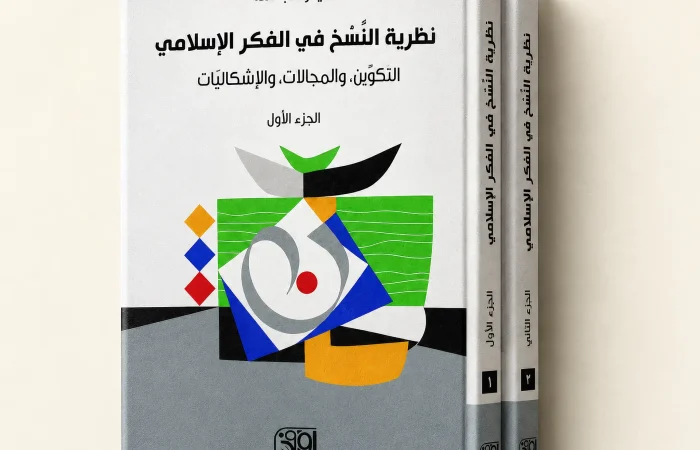
Rawafid Publishing House in Beirut, a branch of Dar al-Mahajja al-Bayda, has released the first edition of Dr Haidar Hobballah’s new book, The Theory of Abrogation in Islamic Thought: Formation, Domains and Problematics, published in two volumes, both released together.
The book offers an extensive critical study of the theory of abrogation (naskh) across the Qur’an, the Sunnah, and the relationship between different religious traditions. It examines the theory from theological and interreligious perspectives, exploring the complex relationship between revealed laws and traditions and the extent to which they may be understood as superseding or affecting one another.
A substantial part of the study is devoted to abrogation within the Qur’an itself. The book critically analyses the arguments and methodological premises upon which the majority of Muslim scholars have relied in affirming the occurrence of abrogation in the Qur’an and Sunnah. It proposes a fresh hermeneutical reading of the subject, arguing that the classical theory of abrogation may be understood, in significant part, as a human scholarly attempt to resolve perceived contradictions or tensions within Islamic scripture. The study suggests that alternative hermeneutical approaches may enable many such tensions to be addressed without recourse to abrogation, or at least substantially reduce the number of cases in which the theory needs to be invoked.
The book also investigates the relationship between naskh and the Imāmī Shīʿī doctrine of badāʾ. It devotes considerable attention to the foundations and implications of badāʾ, examining relevant Shīʿī hadith reports and analysing their content from philosophical, theological and historical perspectives.
Further discussions address the conditions governing the abrogating and abrogated texts, the various forms and classifications of abrogation, and a wide range of related theoretical and interpretative questions. Drawing upon hundreds of primary and secondary sources in several languages, the two-volume study offers a wide-ranging critical reassessment of one of the most significant and contested theories in the history of Islamic legal and scriptural thought.
Dr Hobballah is Senior Lecturer in Islamic Studies and Head of the Department of Hadith and History at Al-Mahdi Institute. The book follows the recent publication of Volume Four of his Jurisprudential Commentary on Minhāj al-Ṣāliḥīn.
The book is available to purchase here.