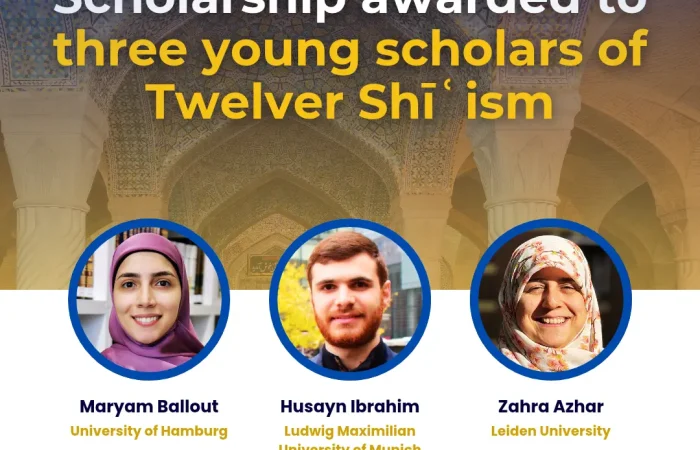
Al-Mahdi Institute is delighted to announce the recipients of the 2026 AMI Doctoral Scholarship, awarded to three outstanding researchers whose work promises to make significant contributions to the field of Shīʿī Studies and beyond.
This year’s awardees, Maryam Ballout, Husayn Ibrahim, and Zahra Azhar, represent a diverse range of scholarly interests, from the theology of religions and Islamic practical philosophy to the social history of the early Imamate.
Maryam Ballout — University of Hamburg

Maryam Ballout is a doctoral researcher in Islamic theology at the University of Hamburg. Her academic formation combines five years of traditional ḥawza training with Western academic study, including a BA in Comparative Religions and an MA in Christian–Muslim Relations. She has been actively engaged in interfaith initiatives and academic programmes across Lebanon, Europe, and the United States, and has worked with the Kircher Network in Spain, an association of Catholic Jesuit universities in Europe, where she contributed to the teaching and organisation of interreligious dialogue programmes and study weeks.
Her doctoral research aims to articulate the foundations of an inclusive Shīʿī theology of religions through critical engagement with contemporary debates on religious pluralism, a field largely shaped by Christian theological concerns and still underdeveloped within Islamic, and particularly Shīʿī, scholarship. Arguing that an inclusive theology of the religious other cannot rest on kalām alone but must also engage fiqh and akhlāq to remain responsive to lived realities, the study analyses the thought of ʿAllāma Muḥammad Ḥusayn Ṭabāṭabāʾī, Sayyid Muḥammad Ḥusayn Faḍlallāh, and Abdulaziz Sachedina to advance a tri-polar model of theology, law, and ethics, with direct implications for interreligious coexistence.
Husayn Ibrahim — Ludwig Maximilian University of Munich

Husayn Ibrahim is a doctoral researcher and lecturer in Philosophy at Ludwig Maximilian University of Munich (LMU Munich). His research focuses on the formation and development of practical philosophy in the Islamic world, particularly through the works of Naṣīr al-Dīn al-Ṭūsī and his predecessors, al-Fārābī, Miskawayh, and Ibn Sīnā. He is a DAAD doctoral scholar and was previously a visiting fellow at the Orient-Institut Beirut. Husayn holds an MA in Islamic Studies from McGill University and an MA in Philosophy from the American University of Beirut.
His doctoral project, The Formation of Practical Philosophy in Islam, examines the 13th-century polymath Naṣīr al-Dīn al-Ṭūsī (d. 672/1274) and his seminal work Akhlāq-i Nāṣirī (The Nasirean Ethics). It argues that this text constitutes the first systematic synthesis of practical philosophy in Islam, integrating ethics, household management, and politics into a unified framework that connects individual moral cultivation to social and political order. Through comparative textual analysis and reception history, including the work’s influence on al-Dawānī’s Akhlāq-i Jalālī, the project challenges narratives of postclassical Islamic philosophy as intellectually stagnant, portraying the period as one of creative synthesis, conceptual innovation, and sustained philosophical development.
Zahra Azhar — Leiden University

Zahra Azhar is a PhD candidate at the Leiden Institute for Area Studies, Leiden University, where she researches the social and intellectual history of early Twelver Shīʿism as part of the project Embodied Imamate: Mapping the Development of the Early Shiʿi Community, 700–900 CE.
Her dissertation centres on the concubine mothers of the Imams and their role in the legitimacy issues surrounding the Imamate, examining how these women influenced the authority and acceptance of the Imams within the Shīʿī community. She is particularly interested in the dynamics of power, slavery, and gender in the history of the early Shīʿī community.
We congratulate all three and wish them every success in their doctoral journeys.